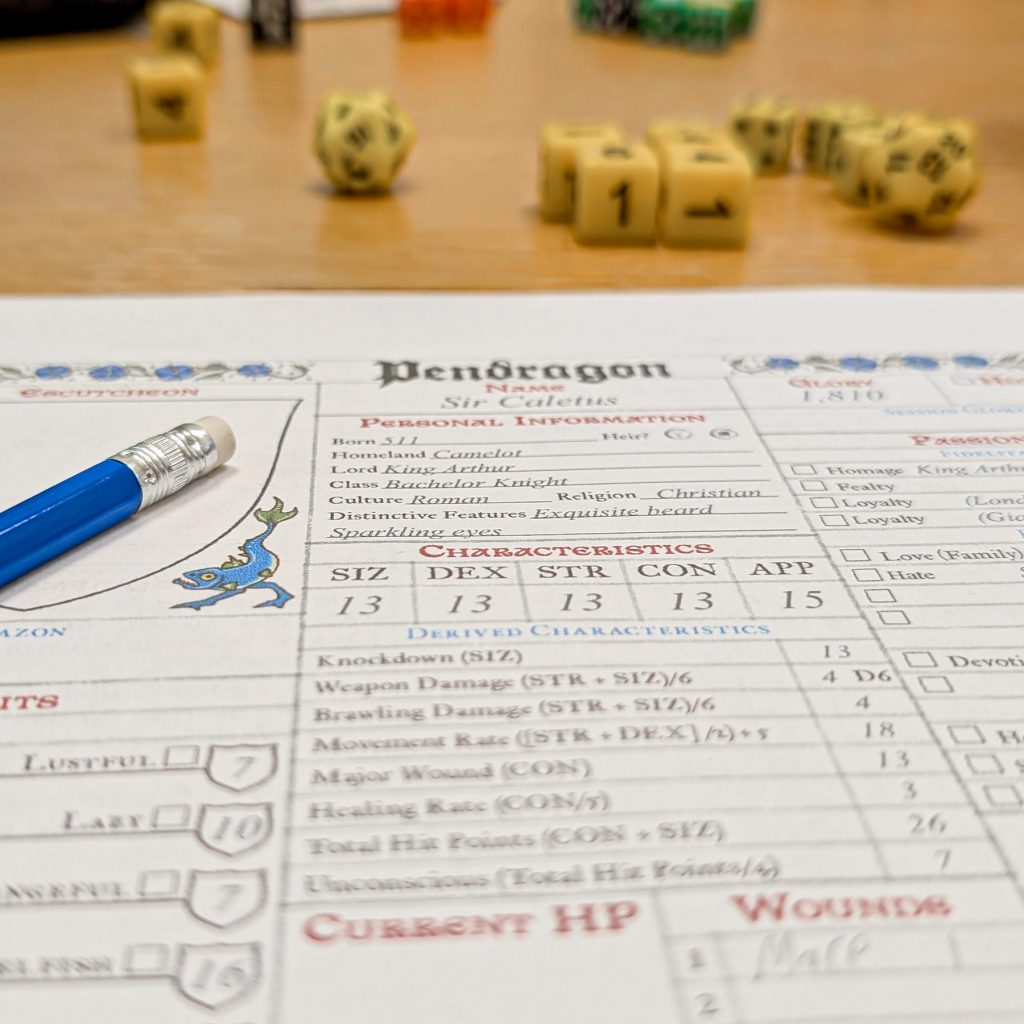
As I mentioned in the May blog, the only game I had signed up for at Chaosium Con 2026 was Pendragon the game of Arthurian knighthood, where you play a knight in the realm of King Arthur, striving to accumulate Glory and be the most honourable and valiant knight you can be. My character was Sir Caletus who in his History and Events had been held captive by saxons and freed by Sir Lancelot. Devilishly handsome but in his traits he is as selfish as he is valorous with a leaning towards being deceitful and suspicious. Not that he had a chance to use it but Sir Calteus had a holy relic – the finger bone of St Lucius.
Our adventure began at a tournament, which served as a nice introduction to the dice rolls and got us into the spirit of things. It was eventful from the off as one character made a particularly unfortunate series of rolls, found themselves gripped by divine inspiration, and then promptly went mad after failing at the tournament. Which seemed a touch extreme, but it was a unique combination of rules based on an unlikely set roll. A replacement character was brought in to complete our group known as the Giant Slayers, and we had some success. So far, so chivalric.
On our way to the castle afterwards, we were set upon by bandits, whom we dispatched without too much difficulty and duly dragged along for justice to the local lord, Lord Claudan. It was at the castle that the real intrigue began. The father and mother of the young lord of the manor recently passed, leaving him as the sole heir. Each evening he would become excitable and animated, only to collapse into exhaustion and lethargy. As knights, it fell to us to investigate. And here is where I have to confess something: my Call of Cthulhu investigator brain completely took over and I was very glad to have the suspicious trait.
We arrived at the castle, sat down to dinner with the household, noticed the boy was unwell, and immediately I was on the case asking questions, probing for information. “Oh, there’s nothing untoward, the boy is just a little tired.” No he isn’t, he looks dreadful, and I intended to find out why. We went on a boar hunt which was enjoyable in itself and one of our party fumbled a hunting roll stumbling across a a stone circle the woods – clearly out of the ordinary. We couldn’t find it again afterwards, naturally, but the mystery of the ailing boy remained unsolved. What could be find out at the feast and dance tonight?
I was surprised there was so much emphasis flirting and that it is a legitimate method of clue gathering! The knight who had discovered the fairy ring presented his findings to the lady of the manor, with whom he had shared a rather pleasant dance the previous evening. She knew nothing about the stones or what they might mean. My own character, who had also enjoyed a dance with the charming medicine lady of the castle, pressed further but everything was apparently fine, and whatever had happened to the boy was apparently something that had just come on a few weeks prior. A passing ailment, nothing more. I was very tempted at this point to suggest the Giant Slayers leave the the castle the next day.
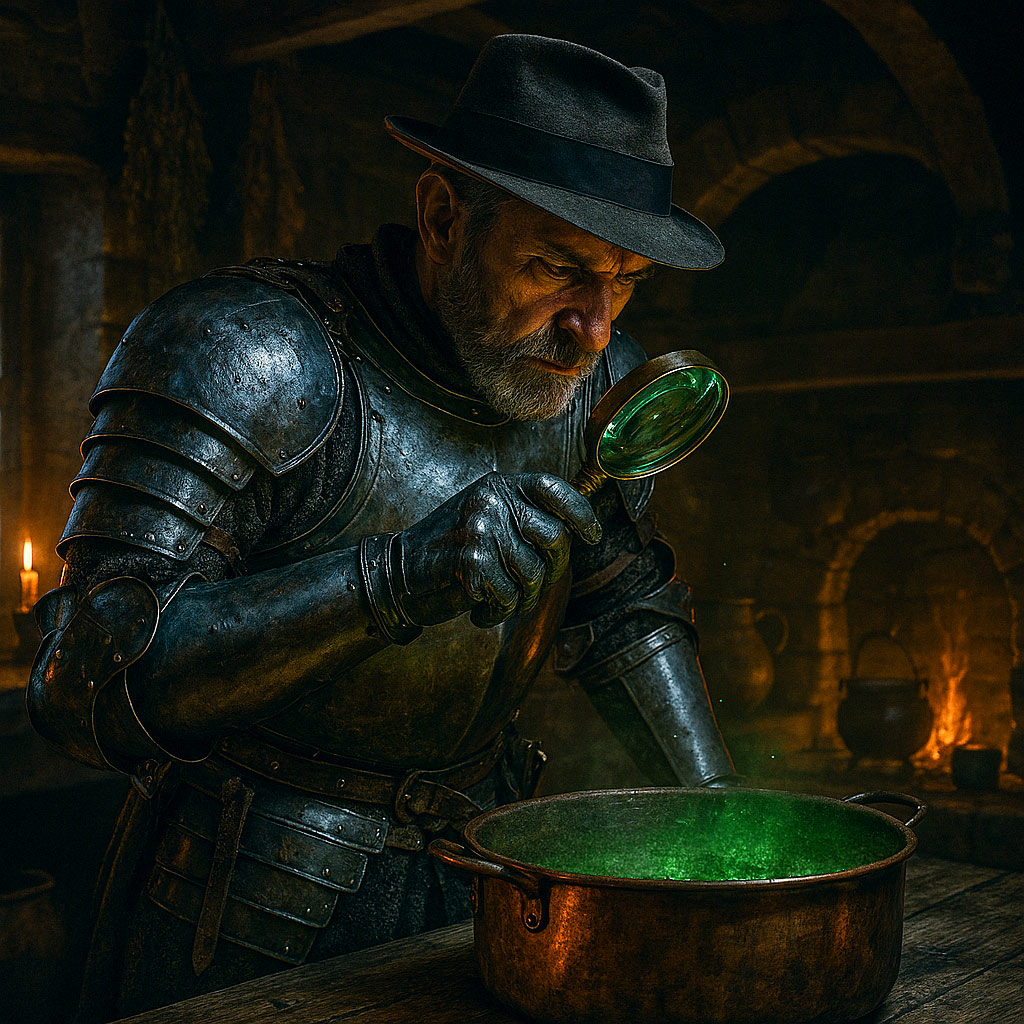
There wasn’t the game mechanics for an idea roll so I had to do a grass roots investigation searching everywhere! When I went to the kitchen, I rolled a critical success, turning up a suspicious residue. From there, we were able to establish that someone was drugging not the young lord himself, but the rest of the household allowing a servant we had never previously encountered to slip the boy out of the castle and away to that stone circle. Time was running short in our game session and so we followed the boy and the servant out to the stone ring and came face to face with what I, as a player, immediately identified as cultists preparing a sacrifice!
They were not cultists but were fairies and the boy had made a foolish wish that he might dance rather than go to bed and the fairies were granting it in the cruel, literal way that fairies tend to do. He was to dance with them every night for a year and a day. Now, as a knight with a very good longsword and a full suit of armour, I was absolutely prepared to explain to the fairy in question why giving the boy back was in their best interests. Apparently, however, fairies are rather formidable, and the rest of the party counselled a more diplomatic approach. So we negotiated with the fairies and the boy was to carry on dancing with a somewhat less demanding but longer schedule and one of the Knights would act as the escort. And the mystery was solved in a rather Vaesen sort of way.
And that was the game over! It was great fun but I do want to reflect honestly on the experience, because I think it says more about me as a player than about the adventure itself. I have since shared this feedback with Ian, the Keeper running the game, and we’ve had a good laugh about it because it really does come down to being a seasoned Call of Cthulhu player. From the moment we arrived I was looking for threads to pull. Why are we at this tournament? Who were those bandits, and why were they attacking travellers on the road? Is there something larger going on? Who are we ultimately going to be sent to vanquish? In Call of Cthulhu, the golden rule is that you never hide a vital clue behind a dice roll. If the investigators don’t find it on the mantelpiece, put it in the next room. If they miss it there, have someone hand the clue to the character telling them its important! Clues should be findable with dice rolls adding extra to the base clue. I raised this with Ian and he took it in good spirit, but it did mean that for much of the session I felt like I was fighting the game rather than playing it. A more seasoned Pendragon player might have settled into the rhythm of it more naturally and trusted that the adventure would reveal itself in time.
The combat system, on the other hand, was pleasingly straightforward with a sword doing 4d6 damage but armour scrubs off most of that. The Traits system on the character sheet was genuinely interesting. Each Trait is an opposing pair like Valorous/Cowardly, Trusting/Suspicious, and so on scored. My knight had a Valour of 16, which meant he was brave to a fault and very much compelled to be at the front of any conflict. He was also highly Suspicious, which, as it turned out, was an excellent trait to bring to a mystery adventure. The Traits actively guide your roleplaying decisions, which I thought was a fun mechanic to have.
Would I play Pendragon again? If someone invited me, yes, I think I would. There is something about King Arthur and the Knights of Pendragon that sparks the imagination! Am I rushing to seek out a game? Probably not whilst there is so much Call of Cthulhu to play. That said, now I know what to expect I can keep my investigator instincts more firmly in check and embrace the dancing and nettle soup. It was a fun few hours, and a memorable part of Chaosium Con 2026.
1 Comment